
The Theology Behind a Cell Phone in the Toilet

Surely the arm of the LORD is not too short to save, nor his ear too dull to hear. But your iniquities have separated you from your God; your sins have hidden his face from you, so that he will not hear. – Isaiah 59:1-2 (NIV)

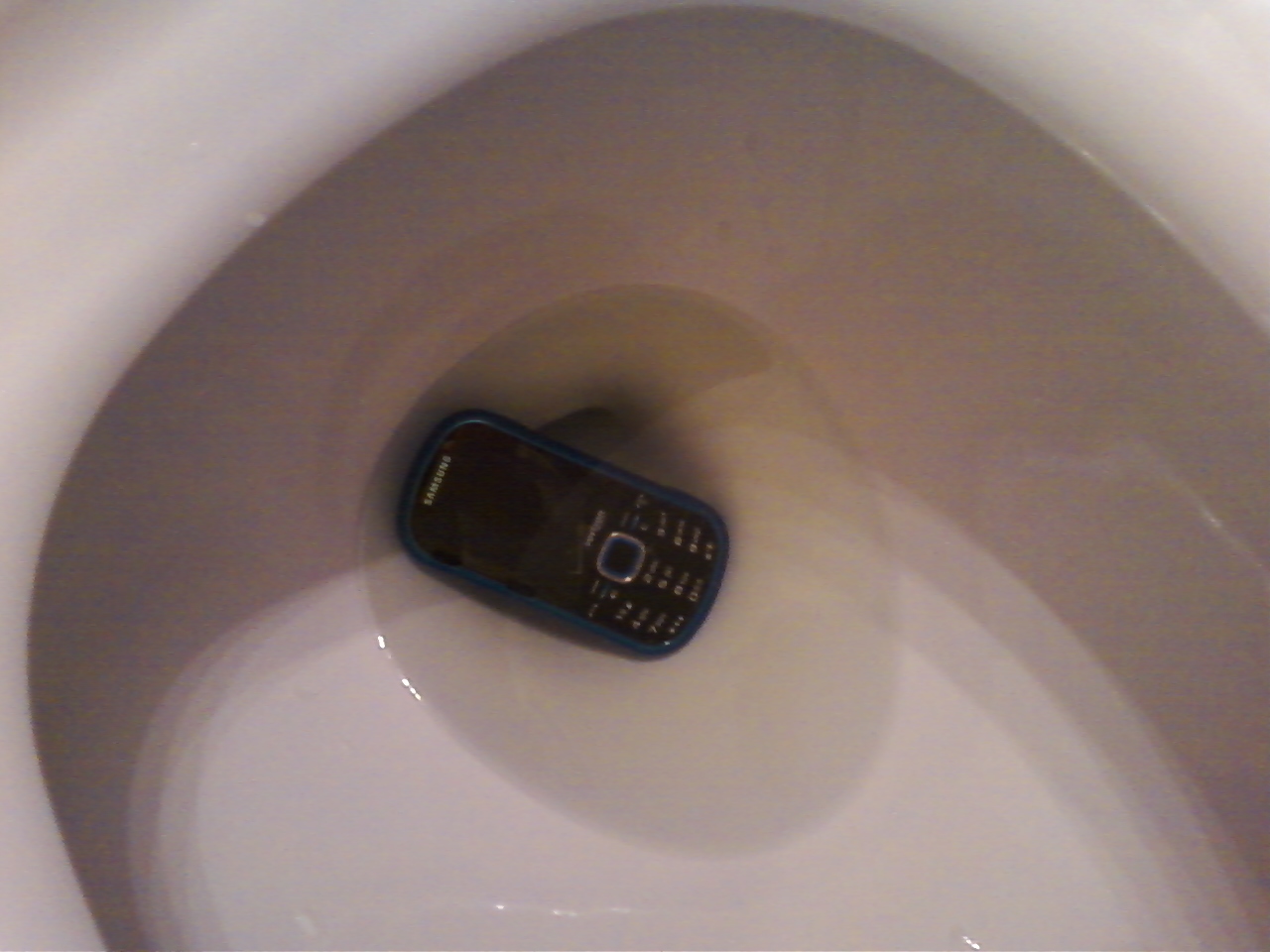
It happened. Out of my pocket and into the toilet it fell. My cell phone made a huge splash in the forbidden place – the depths of the porcelain bowl. And without one thought, I reached directly into the waters of the commode to retrieve the cherished item, my supposed lifeline to humanity. My arm lunged to rescue my phone from the toilet as quickly as I would act in any true emergency. I even let out a scream when I saw the shiny, metallic blue piece of technology hit the water and roll over. So distraught was I, and I don’t even have a touch screen phone!

As soon as I had pulled the phone from the toilet, I ran to my blow-dryer and began my feeble attempt to save my phone from death. Carefully extracting tiny screws, I dried the inner parts and surfaces; but I did so to no avail. My cell phone recovered only slightly and remained inoperable.

After replacing the phone the next day at the store, I quietly asked myself, “Why all the fuss?” I knew the answer. Cell phones have become a critical part of communication. How would I stay in touch with “my people”? What about calls and the esteemed texts? Without my cell phone, I would feel cut off from society as we have come to know it.

Then my mind went to a chapter of the Bible on which I had preached many years before, Isaiah 59. My seemingly desperate experience with the submerged phone directed me to ponder a truly desperate situation – that in which we cannot communicate rightly with God. The prophet proclaims in Isaiah 59:1-2 (NIV), “Surely the arm of the LORD is not too short to save, nor his ear too dull to hear. But your iniquities have separated you from your God; your sins have hidden his face from you, so that he will not hear” (emphasis mine). Just as the commode water stole from me a source of my communication with family and friends, so does my sin swipe my intimacy with my God.

I was instantly convicted of a great truth: I should be immeasurably more horrified by my heart’s plunge into sin than my cell phone’s nose-dive into the toilet! A submerged phone is a temporary glitch in one of the flows of human communication, but my heart’s sinfulness breaks my honest talking with God Almighty. My sin stops God from answering my prayer. Though His ear is not “too dull to hear,” my iniquity causes Him to refuse to hear. While stained with guilt, there remains a block between me and my Lord.

The question, then, becomes, “How quickly do I jump to remove myself from the waters of sinfulness?” I wonder if we are more outraged at the flood of wrong we have fallen into than the plunging of a piece of sensitive technology into water. How apt am I to quickly repent? Does my sin against God cause my spirit to shriek with disgust? Do I genuinely fear lost communication with God? How much does a block in my fellowship with Him bother me? Rightly, God’s refusal to hear us while we willfully sin against Him should spur us to resolve the matter. Much more than I need humans to hear me, I need God to intervene on my behalf.

Have you lately felt a terrible distance between you and God? Do you go through the motions of prayer, but God is not answering? Perhaps we must heed the warning that “[Our] sins have hidden his face from [us]” (Isaiah 59:2, NIV). And in observing this warning we will find a solution much better than vainly blow-drying a thoroughly soaked cell phone. Yes, the heart can be dried of sin by God Himself. When our Lord sees us lying there in the mess of sin, He decides to wash us when we simply and honestly repent. Isaiah 59:16 (NIV) declares, “[God] saw that there was no one, he was appalled that there was no one to intervene; so his own arm worked salvation for him.” God knows we are hopeless when it comes to “drying” ourselves of sin. So He takes matters into His own hands. By His own sacrifice and His own blood He saves us! Jesus is God in the flesh, having appeared to “work salvation” for us. All we need do is repent. “The Redeemer will come to Zion, to those in Jacob who repent of their sins” (Isaiah 59:20, NIV, emphasis mine).

Do you see your fellowship with God submerged in the waters of your sin? What is it in your life that is displeasing Him? React quickly. Tell Him you want to be right and do right. Tell Him you want communication to flow once again. He will then listen, for “His ear is [not] to dull to hear” (Isaiah 59:1, NIV). Get that divine cell phone out of the depths; talk to God again!

The Truth of Noah’s Ark: Faith Without Works is Dead

By faith Noah, when warned about things not yet seen, in holy fear built an ark to save his family. By his faith he condemned the world and became heir of the righteousness that comes by faith. – Hebrews 11:7 (NIV)

Faith is defined for us in Hebrews 11:1 (NIV) as “being sure of what we hope for and certain of what we do not see.” God then goes on to give us many examples of men and women of history who lived by faith. One particular case is that of Noah. Because he is such a well-known biblical figure – and because his life so concisely demonstrates the concept of “faith without works is dead” – we will explore his experience more closely.

First, understand that our culture’s typical rendition of Noah’s ark is inaccurate. Often, we are shown pictures of a small, wooden boat floating easily on calm, blue waters. A few giraffes or elephants may have their smiling heads popping out the top of the ark. Sometimes Noah and his wife are pictured waving contentedly.

In contrast, the actual ark that God instructed Noah to build was 450 feet long by 75 feet wide by 45 feet high. Nearly five times as long as the Santa Maria of Columbus’ voyage and over half the length of the Titanic, the ark was huge and had three decks. Rather than animals sailing along in a fairytale environment, the historical scene at the outset was horrifying. When the rain actually started to fall and the waters rose, I am convinced myriad people began to run for high places, climb trees, and trek up hills with their children. Stunned at the fulfillment of God’s prophetic words to Noah, so many godless people now found themselves face to face with judgment and death. As the ark tossed on the rising waters, no doubt humans were screaming as the waves engulfed them. This was a scene of horror for those outside the formidable boat. We must keep the reality of the event in mind as we continue on in our discussion of faith and works.

After God defines faith in Hebrews 11:1, He explains the working of Noah’s own faith in Hebrews 11:7 (NIV), “By faith Noah, when warned about things not yet seen, in holy fear built an ark to save his family. By his faith he condemned the world and became heir of the righteousness that comes by faith.” Clearly, God warned Noah about things Noah could not see with human eyes. God said in Genesis 6:17 (NIV), “I am going to bring floodwaters on the earth to destroy all life under the heavens, every creature that has the breath of life in it. Everything on earth will perish.” This had to be difficult for Noah to comprehend, as he had never seen a flood before, and life as people then knew it had never been interrupted with sudden, deadly disaster. Yet, with sight unseen, Noah took God at His Word. Noah was warned, and he responded with holy fear. He thought deeply, was circumspect, and considered most seriously the promises and warnings of His Lord. Though the concept of a deadly, colossal flood was foreign to Noah, his faith in God was greater than his unfamiliarity with promised, future events.

Noah’s response of faith was one of action. He believed God, and so he “built an ark to save his family” (Hebrews 11:7, NIV). Building an ark of wood of this great magnitude was no easy undertaking in a world without diesel engines or readily available machinery. Working for perhaps 50-75 years, Noah, his family, and any other people he employed continued the immense undertaking of constructing an ark with three decks and all components necessary to house animal and human life. Under the sun by day and moon by night, the labor went on. Trees were chopped down, and cut, and formed into properly fitting boards. Rooms were constructed, and the boat was covered with pitch inside and out. Day after day, physical labor took place as an ark was formed. Noah’s faith resulted in the work of his hands. An ark would be the end result.

If Noah had not responded with action, his family would have perished in the flood as all other families did. God’s Word went to Noah’s heart, and Noah’s heart responded with action. Quite literally, Noah’s faith without the corresponding works would have been death. The waters would have taken him. How much clearer could the picture be of “faith without works is dead”? Noah’s spoken belief in the coming flood meant nothing unless that belief resulted in the work of his hands and life.

The concept of Noah’s genuine faith becomes even more important as we realize the connection Jesus Christ made between Noah’s day and the end times. Listen carefully to Matthew 24:36-42 (NIV):

    No one knows about that day or hour, not even the angels in heaven, nor the Son, but only the Father. As it was in the days of Noah, so it will be at the coming of the Son of Man. For in the days before the flood, people were eating and drinking, marrying and giving in marriage, up to the day Noah entered the ark; and they knew nothing about what would happen until the flood came and took them all away. That is how it will be at the coming of the Son of Man. Two men will be in the field; one will be taken and the other left. Two women will be grinding with a hand mill; one will be taken and the other left. Therefore, keep watch, because you do not know on what day your Lord will come.

Wow! Jesus Himself parallels the end of time to the days of the flood. He indicates that back in Noah’s time, people just lived life with no thought for coming judgment. They ignored Noah, the Lord’s “preacher of righteousness” (II Peter 2:5, NIV). Despite God’s Word being proclaimed by Noah, people just kept going about their daily business with no concern for God’s reality. Not until the flood hit and the ark’s door was securely closed did people truly believe God’s warning and promise. But it was far too late.

Similarly today, most people get up each day and go through the routine of life without real faith in the warning and promises of God. People brush their teeth, go to work, watch movies, celebrate birthdays, eat dinners and desserts, socialize, and care for so many possessions; and they do not consider God’s sure Word. They live as if life will always go on as it does, despite the corruption of the world and its accompanying deep-seated despair. And yet – without further warning – the end will come. Judgment will hit, God will close out this portion of history; the door of salvation will be shut. As judgment was by water the first time (In Noah’s day), so it will be by fire the second and final time (II Peter 3:3-7, NIV).

The question is, “Are you building your ark?” In other words, is your faith in God resulting in a life that is regularly, securely, and tangibly built on God’s Word? We cannot just say we believe; we must have belief that results in action, for only that kind of belief is real! Had Noah stood with arms crossed and said, “I believe the flood is coming,” but never actually started chopping down trees to build the boat, he would have perished in the waters. And we, too, will die in judgment if we only claim to have faith but do not demonstrate its genuine nature by the accompanying action.

It’s time to build the ark of safety! It’s time to demonstrate the reality of our faith by actually obeying the Word we claim to believe. We need to love unconditionally, serve without jealousy, stop gossiping, cease envying and lusting, share the Gospel in ways sincere and passionate, and shine the light of Jesus in the darkness of this world. We need to get our hands dirty and see some sweat drops pour down our faces as we work out this faith we claim to have.

Remember, Noah’s belief in God had to result in his building of the ark of safety. So, too, our faith must result in the building of our “ark.” If we truly believe, we will live out this life of holiness to God. The world will see our ark as we build it. They many mock us and look at us as if we are crazy, but we must build it in front of them. For, “Faith without works is dead” (James 2:26, KJV).

Sin Brings Death: Does That Make God Mean and Selfish?

For the wages of sin is death, but the gift of God is eternal life in Christ Jesus our Lord. – Romans 6:23 (NIV)

The consequences of sin are not the result of a mean God who delights in making miserable those who oppose Him. The consequences of sin are the result of human opposition to the definition and parameters of the only genuine life available. God created the universe out of nothing at the beginning of time. As much as we may or may not like the fact, God made it all and logically defines it all. Every bit of meaning and every operational standard for the world flows from its Creator. When we rebel against that rightful intention and those uniquely plausible standards, we shun the only life that can make sense and bring authentic joy.

For too long the church of Jesus Christ has allowed the world to think God is simply bossy and unreasonably selfish. It is time we proclaim that God is the Definer of Reality. If we go against His plan, there is simply no other plan to which we can turn except a corrupted version of the real system. God made all reality; there is no other existence outside of Him. Evil is a perversion of His good. Satan is a created being who rebelled. Therefore, when we reject God’s plan, the only option is to become miserable and purposeless. There exists no separate created order where we can define the ways of life and righteousness. We are in God’s cosmos.

Think of it in terms of the simplicity of an automobile. When I drive one, I must operate the vehicle according to the designer’s thoughts. For instance, I will be in big trouble if I say, “Instead of the brake pedal, I choose to use the left turn signal to stop the car.” A severe crash may ensue. Similarly, I won’t be going anywhere if I decide, “I don’t care what the manual says; I am using the radio volume control to accelerate the vehicle.” We find we must operate the automobile according to the designer’s plan if we want a chance of effective driving. When it comes to effective living, we must operate according to the plan of the Grand Designer, the God of the Bible.

Death is the result of sin because God is the Giver of Life. If I go against the Creator, there exists no other life to which I can turn. Death is the only other option. It reminds us of Peter’s response to Jesus’ question when many disciples were walking away from the Lord because of His hard teachings, “You do not want to leave, too, do you?” Peter replied, “Lord, to whom shall we go? You have the words of eternal life” (John 6:67-68, NIV). In other words, Peter was clearly stating that there exists no one else to turn to for true and everlasting life. If we walk away from Jesus, we walk to destruction.

The Good News is found in Romans 6:23 (NIV), “For the wages of sin is death, but the gift of God is eternal life in Christ Jesus our Lord.” After we have turned away from God and die spiritually, that death can be overcome by God alone. Only He can make dead people live. Sick people may have a chance at helping themselves get better, but dead people can do nothing to bring back life. It takes God to restore spiritual life. That is precisely why God put on human flesh and came to our world. As a human, Jesus could pay the price for the sin of people; as God, He can give life back to us. The turning away from God is resolved by turning back to Him in the Person of Jesus Christ. Look to Jesus today. He can forgive your sin and give you a new chance to live according to the only plan that works.

Why Did God Make People?

May the glory of the LORD endure forever; may the LORD rejoice in his works. – Psalm 104:31 (NIV)

A three-year-old recently asked his mom, “Why did God make people?” How should this loving mom answer her son? Why exactly did God make people? Let’s explore the answers and then put them into toddler terms.

Adult Discussion:

God is self-existent. He is the great “I Am.” God was not created by anyone, but rather He created all things out of nothing by His Word (Exodus 3:14; Psalm 33:6,9; Hebrews 11:3). He is eternal and self-sustaining, never growing tired or weary and of infinite understanding. (Isaiah 40:28) When we combine the thought of His eternality with the statement “God is love,” we realize He must have been love always – even in eternity past (1 John 4:8). He certainly was and is love! Because He is triune (1 Peter 1:2), we realize that Father, Son, and Spirit have been in perfect relationship – loving one another always.

When we combine the information above, we discern a few things we can rightfully say to a child about God. We want to be careful not to minimize God by giving children wrong answers. Let’s begin the children’s discussion with the first two points of four:

Children’s Discussion:

1) God did not create us because He was lonely. The Father and Jesus and the Holy Spirit have loved one another forever. God was never alone because He is three persons in One! The Father and Son and Spirit could always talk and be together.

2) God did not create us because He needed us. God does not need anything or anyone. We are the ones who need Him for everything! We would not even be able to breathe if God wasn’t causing our bodies to work (Acts 17:25). God does not need sleep or vitamins or food or anything. He made everything, but no one made Him! He is always strong enough to hold the whole world together and He never even gets tired.

Adult Discussion:

God’s creation brings Him glory. It is right that the holy, self-existent God of the universe be magnified and shown for who He truly is. Psalm 19:1 (NIV) tells us, “The heavens declare the glory of God; the skies proclaim the work of His hands.” The grandeur of creation gives us hints of God’s greatness. How much more, then, do human beings show God’s greatness? For, Psalm 8:5-6 (NIV) proclaims of man “You made him a little lower than the heavenly beings and crowned him with glory and honor. You made him ruler over the works of your hands; you put everything under his feet.” We, as humans, are placed over creation. Therefore, we sound forth by our existence the glory of God even more than other created things. We are made in God’s own image. Colossians 1:16 affirms that absolutely everything was made by Jesus and for Jesus. Our purpose is wrapped up in Him. Very clearly, Psalm 104:1-30 (NIV) declares the greatness of many facets of God’s creation and then culminates with the statement in verse 31, “May the glory of the LORD endure forever; may the LORD rejoice in his works.” We see again here that God’s creation is for His glorification, and He rejoices in what He has made.

Children’s Discussion:

3) Even though we think a lot about ourselves because we are sinners, the world and people are supposed to make us think about God. He is the only One powerful enough to make everything, and He deserves to be thought about. A cute little ladybug should make us think about Jesus and all the neat things He makes! The stars at night should make us think about God and how He is so big and how He is everywhere! Just like ladybugs and stars should make people think about Jesus, our life should make people think about God, too! We were made to point people to how awesome God is!

Adult Discussion:

Revelation 21:1-7 (NIV) shows us what is God’s final plan for both the cosmos and human beings. Having come the first time to earth to stand in our place and pay the price for our sin, Jesus will return to earth a second time to finally and completely remake the world as He intended it before we willfully rebelled against His plan. These verses amazingly reveal to us the heart of God. We are able to see what God desires once our sin and its effects are totally removed from the picture. What God always wanted is spelled out clearly in verses 3-5: “Now the dwelling of God is with men, and He will live with them. They will be his people, and God himself will be with them and be their God. He will wipe every tear from their eyes. There will be no more death or mourning or crying or pain, for the old order of things has passed away. He who was seated on the throne said, ‘I am making everything new!'” We realize here what we lost after the fall of man in the Garden of Eden. We lost our true, unbroken walk with God Almighty. Though we can currently have relationship with Him through Jesus, and His Spirit comes to live in us; there is a day coming when God the Father will “set up shop” right with us! With no fear, regret, or sorrow, we shall walk unhindered with God – always in His incomparable presence!

Children’s Discussion:

4) God made us so that we could have Him as our very best friend! He knows we are the most happy when we are very, very close to Him. On this old Earth, people do not love Jesus like they should. We forget about God too much. We are selfish. But in the New Heavens and New Earth, God will take away sin and all the sad things. No one will want to be apart from Jesus. He will be closer to us than ever, and that is why everyone will be happy forever! No one will get hurt or fight or be sad. Since this is what God wants to happen – and since He will make it happen one day – we should try to make Him our best friend now. He made us to feel right and happy when we walk very close with Him.